
As sustainability becomes a higher priority, our focus is on balancing the needs for human activity while lowering our environmental impact. Nature-based design is advancing these efforts at ECOncrete and elsewhere, as our marine biologists and engineers work together to develop high impact, eco-sensitive solutions.
Biomimicry, or the process of imitating natural design, has a long history in human development. One could argue it is the longest-standing form of human thought to date – and for good reason: Nature has a vast head start in understanding material design, systems integration, and resource management.
However, in this effort to advance through nature’s design, a deeper understanding of the fundamental principles that keep these systems in balance needs to be developed.
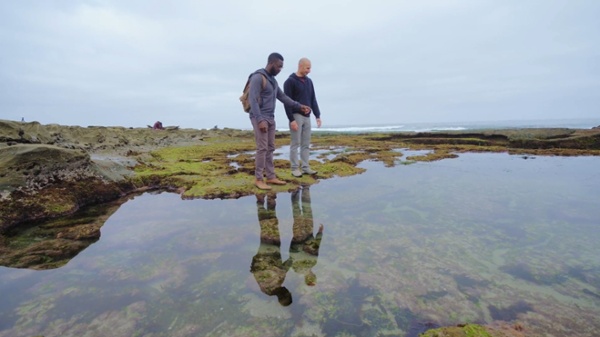
Biologists are re-asserting the importance of biodiversity and pointing to the connections between living things as foundational to all ecosystems. With this in mind, eco-friendly materials, habitat diversity, and creating favorable conditions for natural systems are the new rules in sustainable design.
Emulating natural design elements is not a novel concept, but aligning those designs with already established ecosystems is, and ecologists are signaling biodiversity as the key.
‘Evolve,’ a brand-new docuseries on Curiosity Stream, highlights compelling examples of new nature-inspired trends focusing a recent episode on this innovative coastal development. The host of this series, Patrick Aryee, interviews Dr. Ido Sella, a co-founder of ECOncrete.
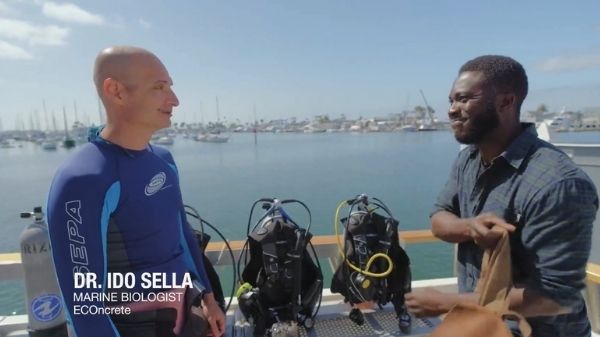
While the duo investigates marina pier structures and ecosystems in the near-shore intertidal zones of San Diego, the differences between healthy systems and those affected by traditional development can be seen firsthand. The negative impact of conventional concrete-based infrastructure throughout the underwater tour becomes clear. Dr. Sella explains how biomimicry should incorporate more bio-sensitive materials and consider the holistic systems approach modeled in nature.
Sustainable design means providing vital infrastructure without compromising local ecology.
“We need to balance sustainability and development. We need to make sure we have a strong waterfront that can support our infrastructure and support human activity. But, we now can do it in a way that can promote biology, provide biodiversity, and increase ecology in the ocean. And, I think this is the win-win solution.” – Ido Sella, Ph.D.
This “livable waterfront” is built with bio-active materials and filled with niche spaces that allow aquatic microorganisms and larvae to gain a footing and thrive – thus giving rise to higher-order species in the chain. The interests here are to design stable systems rather than imposing artificial systems onto the site that degrade the environment over time. By introducing a combination of tide-slowing and spatial design, marine life can establish a biome and grow more complex over time; this is the difference. Dr. Sella makes an excellent point while presenting his company’s eco-engineered revamping of a standard shoreline revetment,
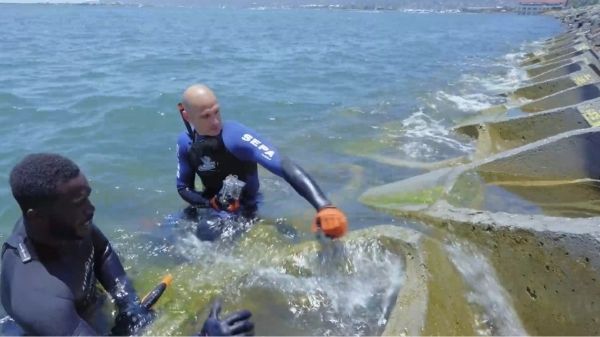
“So, we’re mimicking the features we saw on the natural environment (San Diego, Intertidal Zone) on an artificial waterfront, without compromising the structural performance. […] The species are out there. The problem is they didn’t have, for a very long time, a place to settle and thrive in an urbanized area” – Ido Sella, Ph.D.
Ecologists understand the inter-dependence of natural systems is not an entirely straightforward process. As they seek better ways to model these networks, it’s clear that systems like food chains and carbon sequestration are not linear but are dynamic and multi-directional. Here we see the effects of bio-availability at the lowest chain level and its implications on different layers in ecological design. Still, biomimicry, from the nutrient cycling in coral reefs to the food soil web under our feet, is a roadmap.
The paradigm has shifted to “biologizing” the design process. The idea that the form of an object should grow out of its environment is the foundation of modern biomimicry and is driving the green industry. Sustainable designs offer solutions within a broader scope of our needs and should maintain balance within their habitat.
Our planet is a shared space, and more than that, it is a highly complex and interdependent reality. The industry must seek development solutions that account for integration into a more comprehensive network of ecosystems… basically, nature’s design.