
Initial ecological monitoring results from ECOncrete’s Coastalock installation at the Port of Bilbao show greater species richness on the nature-inclusive armor units compared to adjacent control riprap. The strongest gains are in the rows where intertidal pool habitats have been established.
The findings add to a growing body of monitoring evidence from ECOncrete deployments across Europe and North America, and will be presented by Fernando Colom (ECOncrete) and José Luis García-Mochales (Port of Bilbao Authority) at the XVIII Jornadas Españolas de Ingeniería de Costas y Puertos in Huelva, 13-14 May 2026.
The project began in March 2024 with the installation of Coastalock armor units within the port´s riprap revetment in the intertidal zone of the port´s industrial area. The Coastalock units form part of the active coastal protection infrastructure, integrated directly into the revetment, where they perform the same wave attenuation function as the surrounding riprap while also creating habitat. The units were manufactured locally using a high-density concrete mix to increase unit weight, with ECOncrete providing design specifications, molds, materials, and technical support. The units were placed across three rows with deliberate orientation differences. The lower row was positioned with cavities facing sideways to form cave-like niches and refuges. The upper and middle rows were positioned with cavities facing upward to create tide pools, a high-value habitat that is almost entirely absent from conventional urban port environments.
The project also reflects ECOncrete’s approach to environmental performance at the material level. The concrete mix incorporated steel slag aggregate sourced locally, repurposing an industrial byproduct that would otherwise require disposal. The substitution reduces reliance on virgin limestone extraction, lowers the carbon footprint of the units, and improves wave stability at the same time. Ecological thinking applied not at the end of the process, but at the start.
Beyond the material choices, the project also broke new ground in how ecological performance is measured. Building on the AI-powered monitoring methodology developed with Anemo Robotics and first reported in May 2025, the Bilbao installation now has twelve months of continuous data to draw on. Six custom underwater cameras tracked fish and cephalopod activity across tides, day-night cycles, and seasons, with a purpose-built AI tool identifying species and quantifying their use of space. Traditional quadrat surveys conducted in July 2025 and April 2026 capture the sessile community, covering what video monitoring cannot reach.
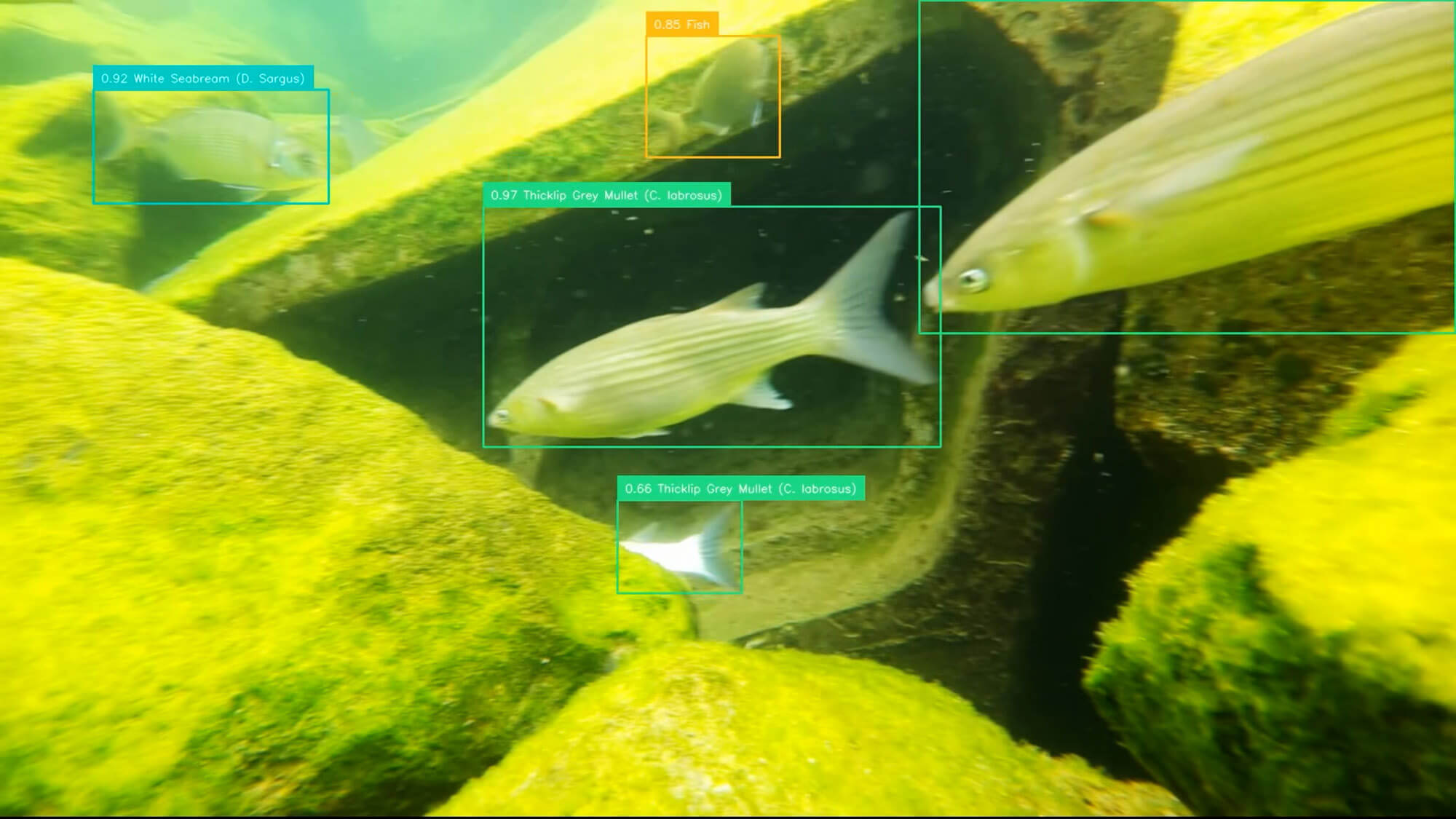
AI tracking confirms that fish and cephalopods are actively using the cavities the Coastalock units provide as refuge, habitat that the control riprap does not offer. The two quadrat surveys demonstrate an ongoing successional process, with a significant increase in both species richness and in the representation of different functional groups between the two samples. 20 months post their deployment, Coastalock units containing water retaining features in the middle and top rows show an increase of 86% and 138% in species richness compared to traditional revetment, with important representatives like the purple urchin, marbled rock crab, and the breadcrumb sponge. Together, the two monitoring streams present a case for integrated ecological assessment of port infrastructure.